
CRM costs for movers usually run about $200–$600 per month for a single-location company that needs leads, dispatch, the crew app and invoicing in one system. MoversTech costs $275 to $400 a month, month to month, with no setup fee. Setup, data migration, texting, card processing and integrations can be billed on top by some vendors, and a moving CRM pays for itself when the crew hours, billed work, booked moves and office time it saves are worth more than its first-year total.
Most moving companies compare CRMs by the monthly price on the pricing page, then find out what the system really costs during the first busy season. Extra office logins, texting volume, card processing, a lead-provider integration and the hours spent moving old jobs across all land on the bill or on the payroll. This guide breaks down CRM costs for movers the way an owner or office manager should budget them: what the subscription runs, what sits outside it, and how to check whether the system pays for itself in crew hours, booked moves and billing time.
How much does a moving company CRM cost?
A moving CRM that runs leads, dispatch, the crew app, invoicing and payments in one system costs about $200–$600 per month for a single-location company in November 2026. MoversTech costs $275 to $400 a month, depending on the size of your operation and the features you need. Each plan includes a set number of user seats, you can add more as your team grows, and billing is month to month, with no long-term contract and no setup fee.
Entry plans from around $100 a month exist, but they usually cover leads and quoting only. Dispatch, the crew app, storage billing and extra office users are where the price of a moving CRM actually gets set, so compare plans by what they include, not by the lowest number on the page. Most vendors price in one of these ways:
- Plan with included seats: a monthly price for the company with a set number of users, and seats added as the team grows. This is how MoversTech prices.
- Flat monthly tiers: one price per tier, with dispatch, the crew app or storage often held back for the higher tier.
- Per office user: a low base fee plus a charge for every login, so the bill rises with each hire.
- Per crew or per truck: licenses for the field side of the business, mostly quote-only.
- Per move (usage-based): a bill that rises with booked moves, so the summer months cost the most.
The pricing model matters as much as the starting price. On published per-user plans, a $125 base with $49 for each added login passes $399 a month by the seventh login, which many movers reach in peak season with seasonal sales staff. The MoversTech plans and what each one includes are listed feature by feature, so you can see what the monthly price covers.
Which pricing model fits your moving company?
Each model is fair in the right situation. The question is how the bill behaves when your season peaks and when your company grows.
Flat monthly plan
One price per month for the company, usually in two or three tiers, often with a set number of users included. This is the easiest model to budget. Check which tier unlocks dispatch, the crew mobile app, storage billing and payroll, because those are the features movers usually need first and vendors often hold them back for the higher tier.
Per office user
A low base fee plus a charge for each login. It works for a two-person office that stays at two people. It gets expensive when you add sales staff for May–September, give the owner and the bookkeeper their own logins, or open a second office. Ask whether crew members using the mobile app count as users.
Per crew or per truck
Licenses tied to the field side of the business. Pricing is mostly quote-only. Watch for minimum license counts and for charges on trucks you only run in peak season.
Per move or usage-based
The bill rises with booked moves. Low in January, high in June. It keeps costs aligned with revenue but makes the summer bill hard to predict, so ask for the price at your busiest month, not your average one.
What costs sit outside the subscription?
The monthly price is rarely the full number. When you request quotes, ask each vendor to put a figure, or a clear “included”, next to every item on this list:
- Setup or implementation fees. A one-time charge to configure the account, rates and documents.
- Data migration. Moving customers, job history, documents and storage accounts out of your current system or spreadsheets.
- Training. Even when it is free, count the office hours your team spends learning the system in the first month.
- Texting and email volume. Some plans cap SMS or charge per message, and business texting in the US requires carrier registration before messages are delivered reliably.
- Payment processing. Card and ACH fees are a percentage of each payment, separate from the CRM. Ask whether the CRM adds its own margin on top of the processor.
- Integrations. QuickBooks, lead providers, VoIP phones and website forms can be included, sold as add-ons or require a paid connector. The CRM integrations every moving company needs are worth pricing before you sign, not after.
- Extra users and seasonal staff. On per-user plans, the cost of the busiest month.
- Support level. Whether phone support and weekend help during peak season are part of the plan or a paid tier.
- Contract terms. Annual prepayment, auto-renewal and cancellation fees.
For comparison, MoversTech lists no setup fees, no per-job or per-lead charges, monthly billing with no annual contract, and free onboarding that includes importing customers, jobs and documents from your current system.
How to estimate the total cost before you buy
Price every option the same way, using a full first year rather than one month:
- Count the office users and crews you run in your busiest month.
- Get the plan price for that peak setup, including the tier that has dispatch, the crew app and any storage or payroll features you use.
- Add one-time costs: setup, migration and paid training.
- Add usage costs at peak volume, such as texts above the plan limit and any CRM margin on card payments.
- Multiply the monthly total by 12 and add the one-time costs. That first-year cost is the number to compare side by side.
Then add the internal cost of switching: the office hours spent on setup and training, multiplied by what those hours cost you. A system that is $50 cheaper per month but takes 40 more hours to set up is not the cheaper option. Price is also only one part of choosing the best moving CRM; a cheaper system that your dispatcher works around with spreadsheets costs more in the end.
What does a CRM save a moving company?
The return on a moving CRM rarely comes from one big win. It comes from small losses that repeat on every job and every week of the season. Most of them sit in five places, and they also explain how moving software keeps overhead costs for movers down as the company grows.
Idle crew time
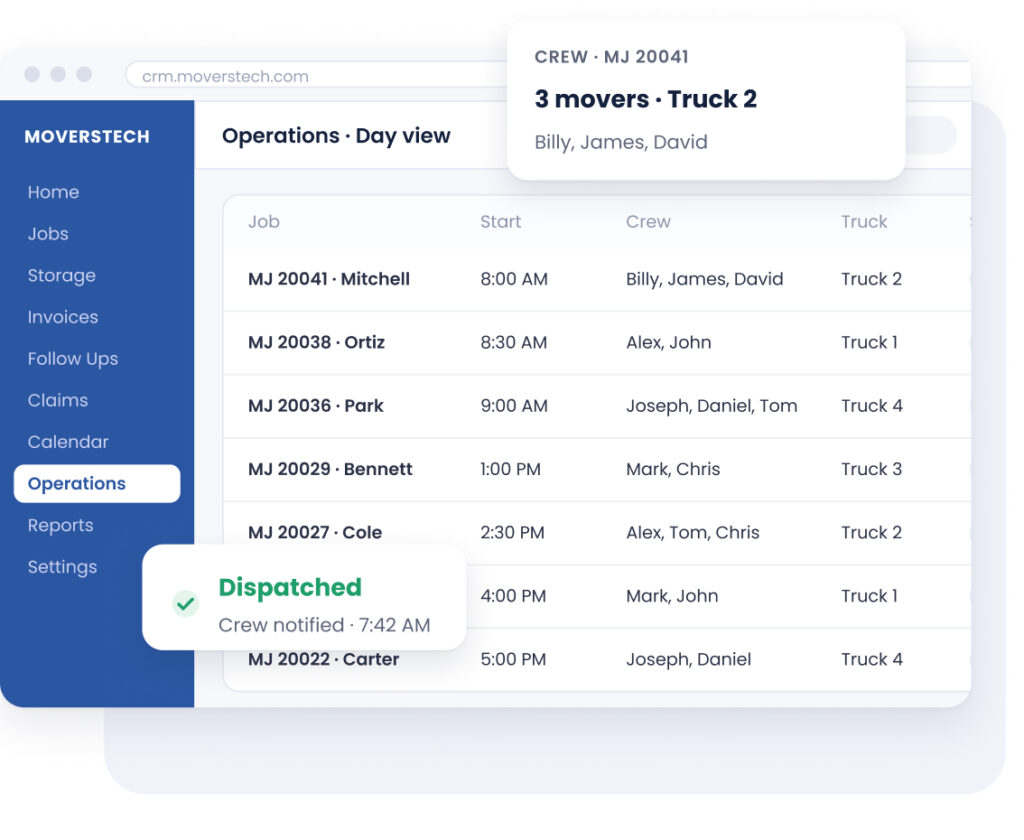
Payroll is the largest cost in most moving companies, so waiting is expensive. Crews wait for a truck, for job details, for a changed start time that nobody passed on. A dispatch board that shows every crew, truck and job in one view, plus job updates sent to the crew app, cuts that waiting. This is the core reason to handle dispatch with moving software rather than a whiteboard and group texts.
Unbilled work between the estimate and the move
A move runs an hour longer, the inventory grows after packing starts, or a long carry was not in the quote, and the price stays where it was. Each gap is small. Across dozens of jobs a month they add up to work that was done but never billed. Rate rules that recalculate labor, mileage, weight or volume charges as the job changes close that gap; this is how moving pricing software automates rates without the office correcting totals by hand.
Fuel on long-distance moves
Fuel rises gradually, so a flat long-distance rate set in spring can lose money by autumn without anyone noticing. Revenue looks fine; margin does not. Seeing cost against revenue per move shows which routes and rates need a fuel or mileage charge before the next season.
Slow billing
When invoices are assembled from crew notes, every job waits for an office review, and payment arrives days later than it could. Invoices generated from the job record, with online payment links, shorten that cycle. The difference between automated invoices and manual billing shows up in cash flow first.
Leads that go cold
Customers request quotes from several movers at once, and the first useful reply often wins. Leads that arrive after hours or on a busy Saturday and wait until Monday are mostly lost. Automatic assignment, instant confirmation by email or SMS and follow-up reminders keep those leads alive. The leads management guide for movers covers the follow-up process in detail.
How do you calculate CRM payback for a moving company?
Put a dollar value on each saving, add them up, and compare the total with the monthly cost of the system. The worksheet below uses example inputs for a single-location company with one 4-person crew working 22 days a month. Replace every input with your own numbers.
| Saving | Formula | Example inputs | Per month |
|---|---|---|---|
| Less crew waiting |
|
||
| Work now billed |
|
||
| Leads kept from going cold |
|
||
| Faster invoicing |
|
||
| Total monthly value |
|
The crew wage in the example is the national median of $18.38 per hour for hand laborers and material movers, from the Bureau of Labor Statistics Occupational Outlook Handbook (May 2025 data), before payroll taxes and workers’ compensation. Your real cost per crew hour is higher, so the example is conservative on that line.
Two formulas finish the calculation:
- Net monthly return = total monthly value − monthly CRM cost (subscription plus usage)
- Payback period in months = one-time costs ÷ net monthly return
With the example value of $2,629 and a monthly cost of $400, the top of the MoversTech price range, the net return is $2,229 per month, and even $1,500 in one-time costs is paid back within the first month. Halve every line in the table and the value is still $1,315 a month, more than three times that cost. The exercise is still worth doing with real numbers: it shows which saving matters most in your company, and that tells you which features to test hardest in a demo.
How do CRM costs change as a moving company grows?
CRM costs for movers also change with the business. A CRM that fits a one-location company with two crews can become the wrong price, or the wrong system, after a few changes:
- Adding storage. Recurring storage invoices and unit tracking usually sit in a higher tier. If storage is part of the plan, see how storage management in a moving CRM handles recurring billing.
- Running payroll in the CRM. Crew hours, commissions and tips tracked against jobs replace a separate spreadsheet, but often cost more.
- Opening a second branch. Multi-branch reporting and separate rates per location are usually top-tier features.
- Adding office staff. On per-user plans, every hire raises the bill.
Price the plan you expect to need in 18 months, not only the one you need today, and ask how upgrades and downgrades work. MoversTech keeps this to two plans, from $275 to $400 a month: Growth for single-location moving companies, and Professional for companies with storage, payroll or several branches. Both are billed monthly, and you can switch plans without a setup fee.

CRM costs for movers are worth comparing as a first-year total
CRM costs for movers are easier to judge once every option is priced the same way: the plan you need at peak season, every cost outside the subscription, and the crew hours, billed work, booked moves and office time the system gives back. On those numbers, the cheapest monthly price is rarely the cheapest system. MoversTech is built for moving companies, with dispatch, the crew app, rate rules, invoicing and lead follow-up in one CRM, for $275 to $400 a month with no contract and no setup fee. Schedule a private demo to see how the numbers would work for your company.
Frequently Asked Questions
Is moving software expensive?

A moving CRM that covers leads, dispatch, the crew app and invoicing costs about $200–$600 per month for a single-location company in November 2026, and MoversTech costs $275 to $400 a month depending on size and features. Against crew wages of at least $18.38 per mover per hour (the May 2025 national median for hand laborers and material movers), a system that saves a few crew hours a week or books one or two extra moves a month usually covers its own cost.
How do you estimate the total cost of a CRM before buying?
Price the plan for your busiest month, including every office user, crew and feature tier you need. Add one-time costs such as setup, data migration and paid training, then usage costs such as extra texts and any margin on card payments. Multiply the monthly total by 12 and add the one-time costs to get a first-year cost you can compare across vendors.
What hidden fees exist in CRM pricing plans?
The most common are setup or implementation fees, data migration charges, per-message texting fees or SMS caps, a margin on card processing, paid integrations for QuickBooks, lead providers or VoIP, charges for extra users, paid support tiers, and annual contracts with cancellation fees. Ask each vendor to write a price or "included" next to each one.
How much does a CRM cost per user?
It depends on the pricing model. Per-user systems charge for every office login, typically $29–$49 per added user on published plans, so the bill rises with each hire. Other CRMs, including MoversTech, include a set number of user seats in each plan and let you add seats as the team grows.
How much does it cost to migrate data into a new moving CRM?
Some vendors charge a one-time migration fee and others include it in onboarding. Ask exactly what is imported, such as customers, job history, documents and storage accounts, and in what format. MoversTech imports customers, jobs and documents from your current system as part of onboarding, at no extra cost.
What is the cheapest moving CRM with dispatch?
Entry plans from around $100 a month usually cover leads and quoting only, without dispatch or the crew app. Plans that include leads, dispatch, the crew app and invoicing typically start around $200–$300 a month, and MoversTech starts at $275 a month, month to month, with no setup fee. Compare the first-year cost of the plan that has everything you use, not the lowest advertised price.